
In Germany’s small and medium-sized enterprises and high-tech manufacturing industry, reliability is never an optional feature but a hard standard that must be met. Once a push button switch is installed on a CNC machine tool, medical diagnostic equipment or industrial control panel, it becomes a key link connecting the operator’s intent and machine operation – simply put, it is the “bridge” for human-machine interaction.
Despite being a small 16mm component, a single failure can lead to downtime losses and additional labor costs of thousands of euros, not to mention the impact on corporate reputation. The “1 million mechanical cycles” we often refer to is actually a clear dividing line: distinguishing between “disposable components” that may fail after a single use and “industrial assets” that can work stably for the long term.
But how is such a long service life achieved? In fact, it is simply the result of a good combination of materials science, precision motion design and rigorous testing. In this guide, we will take a detailed look at how our high-durability push button switches are designed, and how each core component coordinates to deliver stable performance over one million cycles.
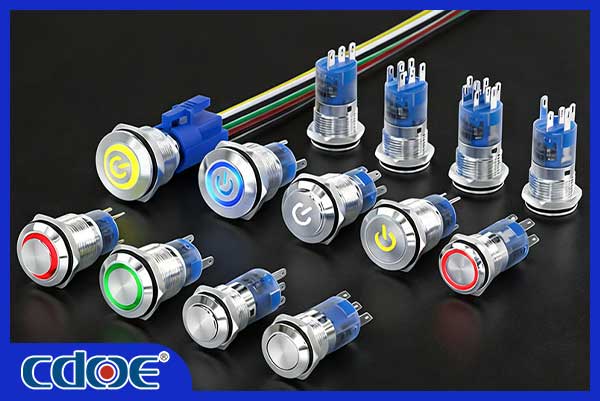
1. Housing Material: Structural Integrity Engineering
The housing is the first protective barrier of a push button switch. After one million operations, it must maintain precise internal alignment, without deformation, corrosion or tolerance deviation, so as to provide a stable working environment for the internal mechanical components.
1.1 Industrial Workhorse: 304 Stainless Steel (Standard)
For 90% of industrial scenarios, 304 stainless steel is our standard configuration and the most recommended housing material, whose performance fully meets the basic reliability requirements of German industry.
- Mechanical Strength: 304 stainless steel has a tensile strength of over 515MPa, capable of withstanding repeated physical impacts and vibrations in industrial sites. It will not experience tolerance deviation after long-term use, and can always keep internal components in the correct position.
- Corrosion Resistance: It effectively prevents oxidation and rust in ordinary factory environments, humid conditions and common industrial liquids, making it fully suitable for most German industrial scenarios.
- One Million Cycle Logic: The key is that 304 stainless steel maintains shape stability under continuous pressure, ensuring internal mechanical components are always centered and free from frictional wear – this is where cheap plastic switches are most prone to failure, and it is the foundation for our ability to achieve one million cycles.
1.2 Marine and Chemical Upgrade: 316L Stainless Steel (Custom Available on Request)
While 304 stainless steel is durable, some German projects involve extreme operating environments. For such scenarios, we offer custom 316L stainless steel solutions, along with professional engineering advice to avoid over-engineering and unnecessary costs for our customers.
- Pitting Corrosion Resistance: 316L stainless steel contains molybdenum, giving it far superior resistance to pitting and crevice corrosion compared to 304. It is particularly suitable for marine environments such as North Sea wind farms, or pharmaceutical production lines that use strong chlorine-based cleaners, maintaining structural integrity even in extremely corrosive conditions.
- Engineering Advice: Our technical team carefully evaluates the operating environment for customers to determine whether 316L stainless steel is necessary, ensuring 100% reliability without increasing costs due to over-engineering – in line with the core German engineering principle of “precision adaptation and cost control”.
Consult an Expert – Unsure whether you need 304 or 316L?
2. Electrical Contact Engineering: Overcoming Arc Erosion
If the housing is the foundation, the electrical contact section is the “heart” of the switch – even if the mechanical structure is flawless, a faulty contact renders the entire switch useless. Few people know that every time a loaded button is pressed, a tiny spark, or arc, is generated between the contacts. Over time, such arc erosion is the main cause of contact failure.
2.1 Silver-Nickel (AgNi) Alloy Contacts
Our high-current push button switches feature high-quality silver alloy contacts, optimally designed to address arc erosion, balancing conductivity and durability to fully meet the requirements of industrial high-current scenarios.
- Anti-Welding Performance: Our silver alloy contacts are processed with a special technology, effectively preventing contact adhesion under high surge current, avoiding switch jamming, ensuring precise reset after each press, and eliminating machine downtime caused by contact failure.
- Conductivity: Silver alloy itself has excellent electrical conductivity, strictly controlling contact resistance below 50mΩ, minimizing heat generation during current passage, preventing damage to internal components from overheating, effectively extending contact service life and supporting one million cycle requirements.
2.2 Gold Plating for Logic Level Signals
In German automation systems, switches mostly use low voltages of 5V or 24V to send signals to PLCs (Programmable Logic Controllers). At such low energy levels, the oxide layer on the contact surface cannot be burned off, so the contact material must be specially treated.
Advantages of Gold: Gold-plated contacts effectively prevent oxidation and ensure stable signal transmission. Even after the 1,000,000th use, the signal transmission performance remains the same as the first time, without signal distortion that could cause machine misoperation, fully meeting the high-precision requirements of German automation systems.
3. The Core of the Switch: Fatigue-Resistant Springs
The spring is the most stressed component in a push button switch – after one million presses and resets, it must maintain elastic stability and return to its original height precisely every time, ensuring consistent and reliable switch operation.
We use high-quality piano wire springs with a fatigue strength of over 1800MPa. After precise heat treatment, the deformation is less than 0.01mm even after 1 million repeated compressions, and the fluctuation of the elastic coefficient is controlled within ±5%. This ensures the long-term durability of the switch from the core component level.
4. Precision Kinematics: “Wiping” Action and Stroke Optimization
Friction is the main enemy of switch life. The core of our internal mechanical design is to minimize unnecessary wear while ensuring operational feel, achieving both “durability and usability”.
4.1 Wiping Action Design: Core Logic for Reducing Parasitic Wear
We have designed a precise “wiping” action for the contacts. When the contacts make contact, there is a slight relative sliding (wiping angle controlled between 3° and 5°), which effectively wipes off oxide layers and contaminants on the contact surface, avoiding heat generation and wear caused by poor contact, and also reducing the risk of contact adhesion, escorting one million cycles.
4.2 Optimized Stroke Calibration
After extensive engineering tests, we have precisely adjusted the switch stroke distance to balance operational feel and extended mechanical life. Excessively long stroke increases impact on internal components and accelerates wear; excessively short stroke makes it difficult for operators to confirm actuation, leading to errors. Our carefully designed “optimal stroke” ensures clear operational feedback while minimizing internal mechanical wear to the greatest extent.
Request Engineering Samples – Experience the tactile feel and excellent quality meeting German “Haptik” standards for yourself.
5. Environmental Sealing: Comprehensive Protection to IP67 Standard
In Germany, contaminants such as dust, oil and coolant can affect switch life in scenarios ranging from automobile assembly plants to outdoor power grids. Therefore, effective environmental sealing is crucial for achieving one million cycles.
5.1 O-Ring Sealing Technology
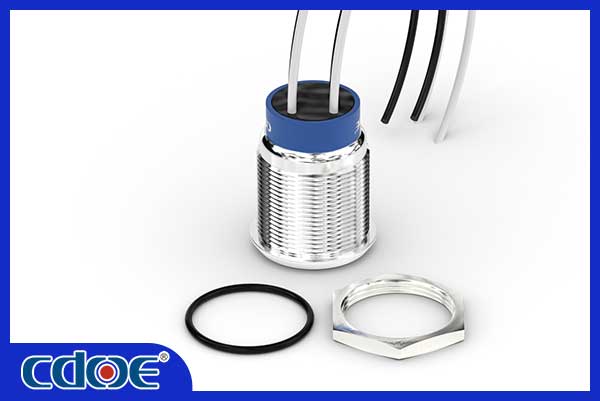
To protect internal mechanical devices and electrical contacts from damage during one million cycles, we use high-performance fluororubber or silicone O-rings combined with a precision sealing structure to achieve comprehensive protection.
- IP67 (Standard): Simply put, it is completely dust-tight and can withstand immersion in 1 meter of water for up to 30 minutes without failure, suitable for complex industrial environments including outdoor, humid and dusty conditions.
- Maintenance-Free Operation: It effectively blocks oil, coolant and fine dust from entering the switch interior, ensuring internal lubricants remain clean and free from lubrication failure that could cause mechanical wear, enabling long-term maintenance-free operation and helping customers reduce subsequent maintenance costs.
6. Tactile Consistency: Adaptation to German “Haptik” Standards
In the German engineering field, the “feel” of a switch is also an important quality metric. A durable switch must maintain the same precise operational feel from new until the end of its service life – this is one of the core requirements of German engineers and operators for switches.
6.1 Constant Actuation Force
We use a precision fast-response structure to set a constant actuation force for the switch, approximately between 1.5 and 2.5N. When pressed, it provides clear tactile and auditory feedback, with an actuation feedback error of less than 0.1mm.
Operator Confidence: This distinct “click” sound effectively prevents accidental double presses. Even in noisy factory environments, operators can clearly confirm that the signal has been sent, improving both operational safety and efficiency, and fully complying with German “Haptik” tactile standards.
7. Automated Lifecycle Testing: Verifying Reliability with Data
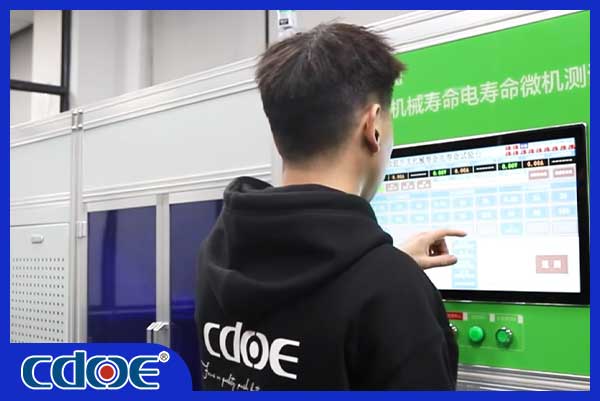
The durability of one million cycles cannot rely solely on design theory, but must be verified through rigorous testing. Our laboratory is equipped with professional pneumatic testing equipment that performs 24/7 full lifecycle testing on push button switches, ensuring every product meets our promised standards.
- Mechanical Life Test: Cyclic pressing at a frequency of 10 times per second under no-load conditions, monitoring structural integrity and reset consistency of the switch to ensure no mechanical failure after 1 million cycles.
- Electrical Life Test: Cyclic testing under full rated load (voltage ranging from 24V to 250V, current from 0.1A to 10A for different models), real-time monitoring of contact corrosion and contact resistance changes to ensure consistent electrical performance.
- Salt Spray Test (ISO 9227): Exposing the switch to a 5% concentration salt spray environment for 48 consecutive hours to ensure 304 and 316L housings and seals can withstand accelerated corrosion and adapt to complex corrosive environments.
8. Customization for German OEM Manufacturers: Precision Adaptation to System Requirements
A switch capable of one million cycles only has real value if it can be perfectly integrated into the customer’s system. We offer comprehensive customization services tailored to the assembly needs and system standards of German OEM manufacturers.
8.1 Permanent Laser Marking
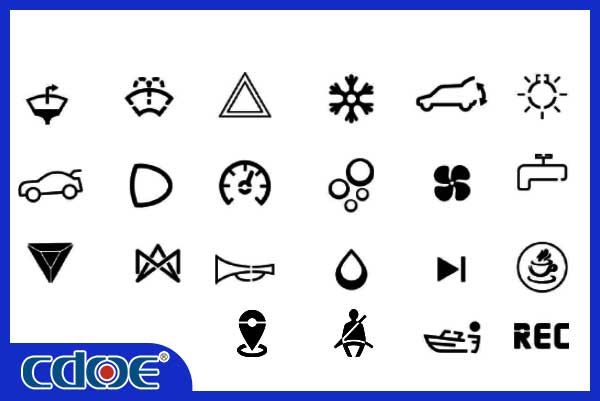
Operation symbols on the switch must never fade or peel off. We use high-contrast fiber laser marking technology for all icons and German text (e.g., Start, Stopp, Not-Aus), fully complying with German industrial marking specifications.
Durability: Unlike traditional ink printing, laser marking penetrates the interior of the housing material. It will not fade even when wiped with solvents, soaked in oil or rubbed with thick gloves, ensuring clear identification after long-term use and improving operational safety.
8.2 Connection Solutions
To help German manufacturers improve assembly efficiency and reduce assembly costs and error rates, we offer a variety of connection solutions fully adapted to the assembly processes of German OEM manufacturers:
- Custom Pre-wired Terminal Service (additional customization fee applicable): We pre-wire the terminals for customers, who can install them directly upon receipt, reducing on-site assembly time, labor costs and the probability of wiring errors.
Conclusion: Total Cost of Ownership (TCO) vs. Initial Price
For German project managers and procurement managers, choosing a push button switch is not about the lowest initial price, but about calculating the total cost of ownership (TCO) – the actual cost over the long term.
- Cheap Alternatives: A 1-euro push button switch typically fails after 50,000 cycles. To achieve 1 million cycles, 20 replacements are required, plus 20 on-site service calls, with significant downtime in between. The total cost is far higher than the professional solution.
- Professional Solution: Our high-durability push button switch can withstand 1 million cycles, with one-time installation and no subsequent maintenance, effectively reducing downtime losses, replacement costs and labor costs – making it more cost-effective in the long run.
At Yueqing Dahe Electric Co., Ltd., we have always focused on providing such “professional solutions”. Our standard 304 stainless steel switches serve as a reliable backbone for your machines, while our custom 316L products can handle the harshest environments on earth. We also offer German technical support and local delivery services to solve your worries.
We look forward to providing precise, durable and high-reliability push button switch solutions for your next industrial project.
Learn about product information – Compare our 12mm, 16mm and 22mm series and get detailed technical parameters.