
Industrial push button switches are widely used in automation equipment, electrical control panels,machinery, EV charging equipment, medical devices, vending machines and other control systems.This guide explains how to choose the right push button switch based on mounting size, voltage,current rating, contact configuration, momentary or latching operation, IP protection, materialand application environment.Updated guide for industrial, outdoor and control panel applications.
Table of Contents
- Quick Answer
- Push Button Switch Selection Checklist
- Push Button Switch Selection Basics
- Key Push Button Switch Terms
- How to Choose the Mounting Size of a Push Button Switch
- How to Choose the Voltage Rating of a Push Button Switch
- How to Choose the Current Rating of a Push Button Switch
- How to Choose NO, NC or NO+NC Push Button Contacts
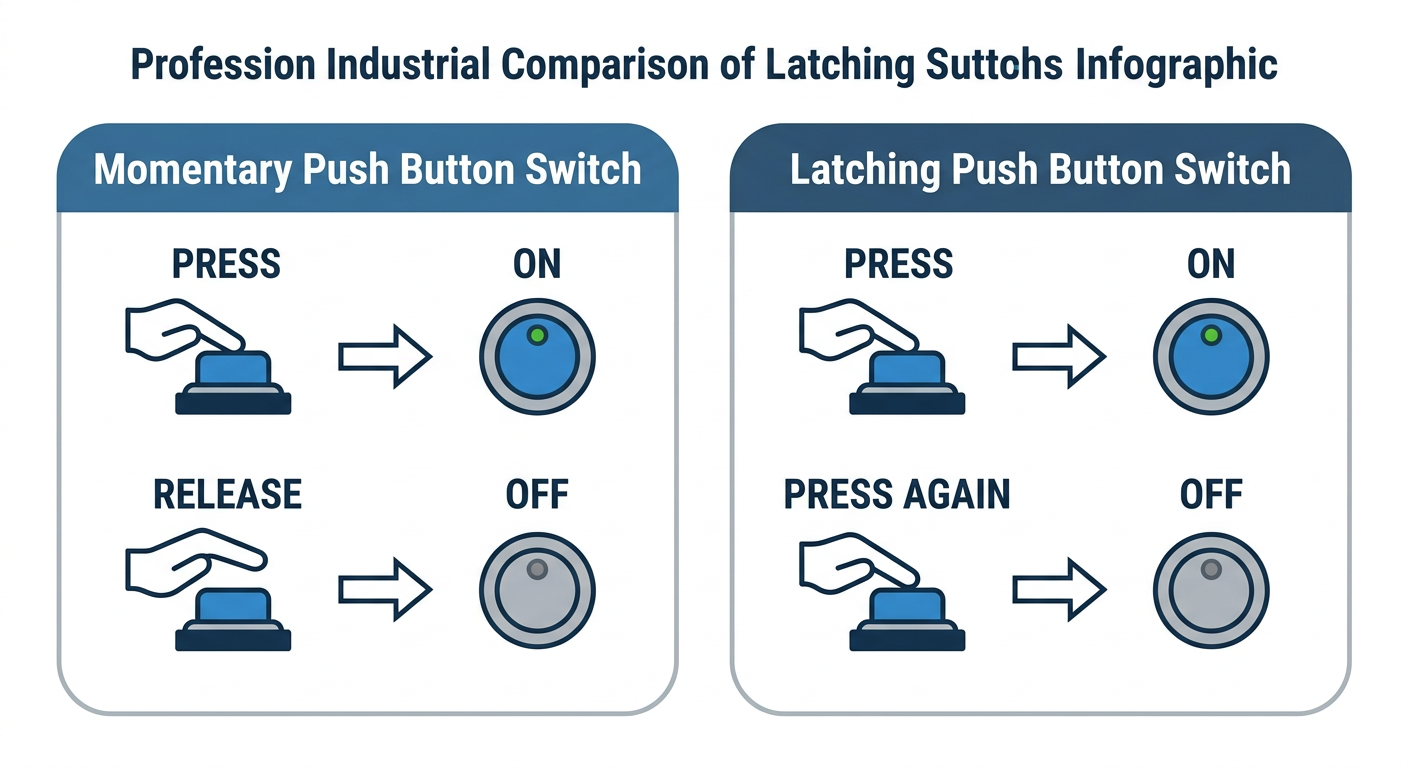
- How to Choose Momentary or Latching Push Button Switches
- How to Choose the IP Protection Rating
- How to Choose Push Button Switch Material
- How to Choose a Push Button Switch for Different Applications
- Push Button Switch Selection Decision Tree
- Common Push Button Switch Selection Mistakes
- Push Button Switch Selection Guide Table
- CDOE Push Button Switch Capabilities
- FAQ About Push Button Switch Selection
- Conclusion
Quick Answer: How to Choose a Push Button Switch
To choose the right push button switch, first confirm the panel mounting hole size, such as 16mm, 19mm or 22mm. Then match the switch contact voltage and current rating to the control circuit. Choose NO contacts for start or trigger functions, NC contacts for stop or safety functions, and NO+NC contacts when one button must provide signals to different circuits.Select momentary operation for temporary commands and latching operation for maintained ON/OFF control. Finally, choose the IP rating and housing material according to the installation environment.
for a standard industrial control panel, a 22mm momentary push button with suitable NO or NC contacts and an IP54 to IP65 rating is often selected. For outdoor or wet applications,consider IP65, IP67 or IP68 according to the actual water exposure.
Push Button Switch Selection Checklist
Before selecting a panel mount push button switch, engineers and purchasing teams should confirm both the mechanical installation requirements and electrical circuit requirements.
- 1.Confirm the panel cutout diameter: 10mm, 12mm, 16mm, 19mm, 22mm, 25mm, 28mm, 30mm or 35mm.
- 2.Check the panel thickness and installation dimensions.
- 3.Match the contact voltage rating to the control or load circuit.
- 4.Check the contact current rating, load type, inrush current and switching frequency.
- 5.Select NO, NC or NO+NC contacts according to the control logic.
- 6.Choose momentary operation for temporary commands or latching operation for maintained states.
- 7.Select the IP rating according to dust, water spray, rain or immersion exposure.
- 8.Choose stainless steel, brass, nickel-plated brass or plastic housing according to the environment.
- 9.For illuminated models, check LED voltage and LED color separately from the switch contact rating.
Push Button Switch Selection Basics
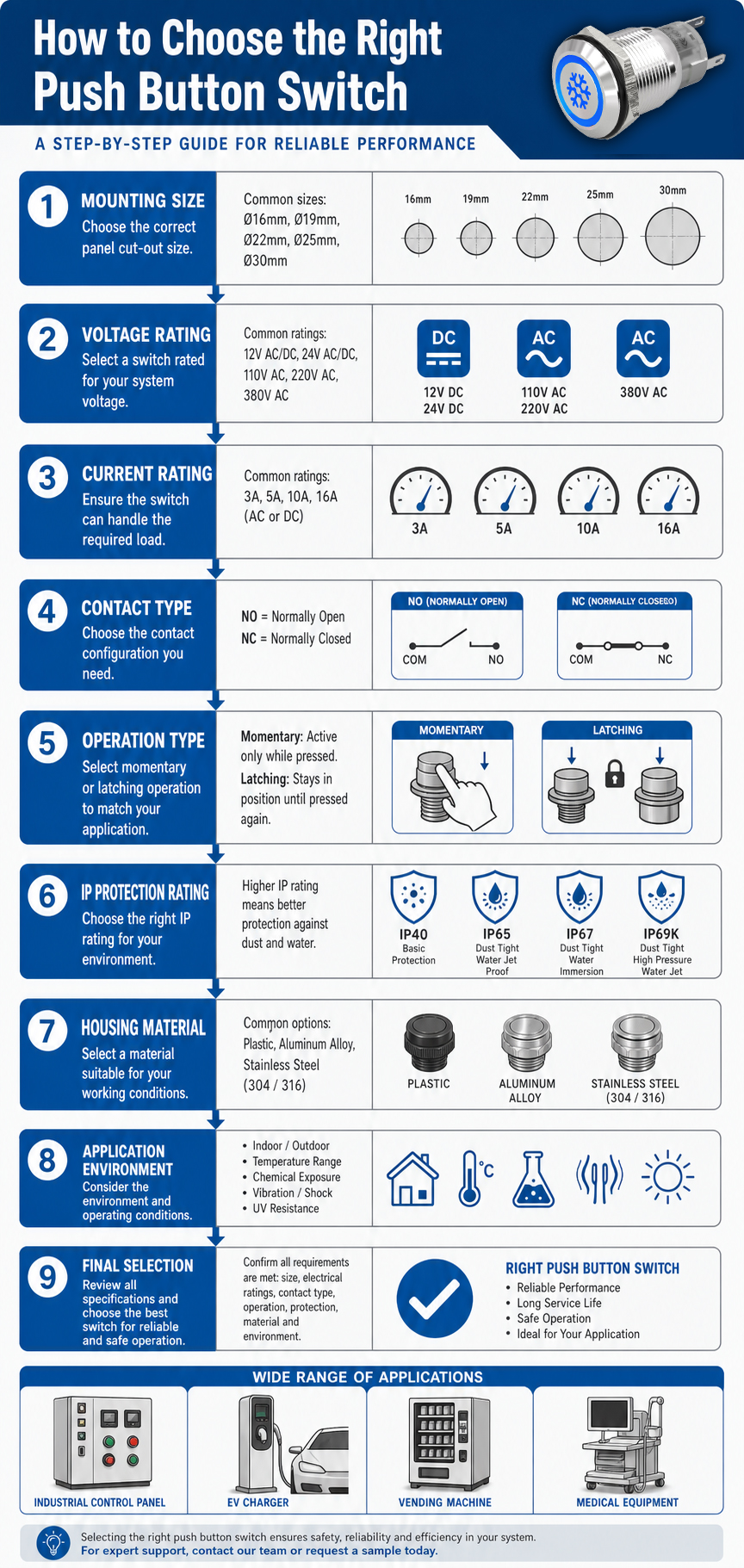
A push button switch is a manually operated electrical switching device used to control a circuit by pressing or releasing an actuator. Depending on the design, a push button can provide a momentary signal, maintain an ON/OFF state, control a PLC input, activate an indicator or interrupt a control circuit.
| Selection Factor | What to Check | Why It Matters |
|---|---|---|
| Mounting Size | Panel cutout diameter and panel thickness | Ensures the switch fits the control panel or machine housing |
| Voltage Rating | AC or DC operating voltage | Prevents electrical mismatch and overload |
| Current Rating | Load current, load type and inrush current | Protects switch contacts and improves electrical life |
| Contact Configuration | NO, NC or NO+NC | Determines start, stop, trigger or safety control logic |
| Operation Type | Momentary or latching | Determines whether the switch returns or maintains its state |
| IP Protection | Dust, water spray, rain, washdown or immersion exposure | Determines environmental suitability |
| Material | Metal, stainless steel, brass or plastic | Determines durability, corrosion resistance and appearance |
Key Push Button Switch Terms
The following terms are commonly used in industrial push button switch specifications and datasheets.
| Term | Meaning |
|---|---|
| Mounting Size | The diameter of the panel hole required to install the switch. |
| NO Contact | Normally open contact that closes when the button is pressed. |
| NC Contact | Normally closed contact that opens when the button is pressed. |
| Momentary | The switch returns to its original state after the actuator is released. |
| Latching | The switch maintains its state until it is pressed or operated again. |
| IP Rating | Protection level against dust and water ingress. |
| LED Voltage | The voltage required to operate the indicator light circuit. |
| Contact Rating | The voltage and current capacity of the mechanical switching contacts. |
How to Choose the Mounting Size of a Push Button Switch?
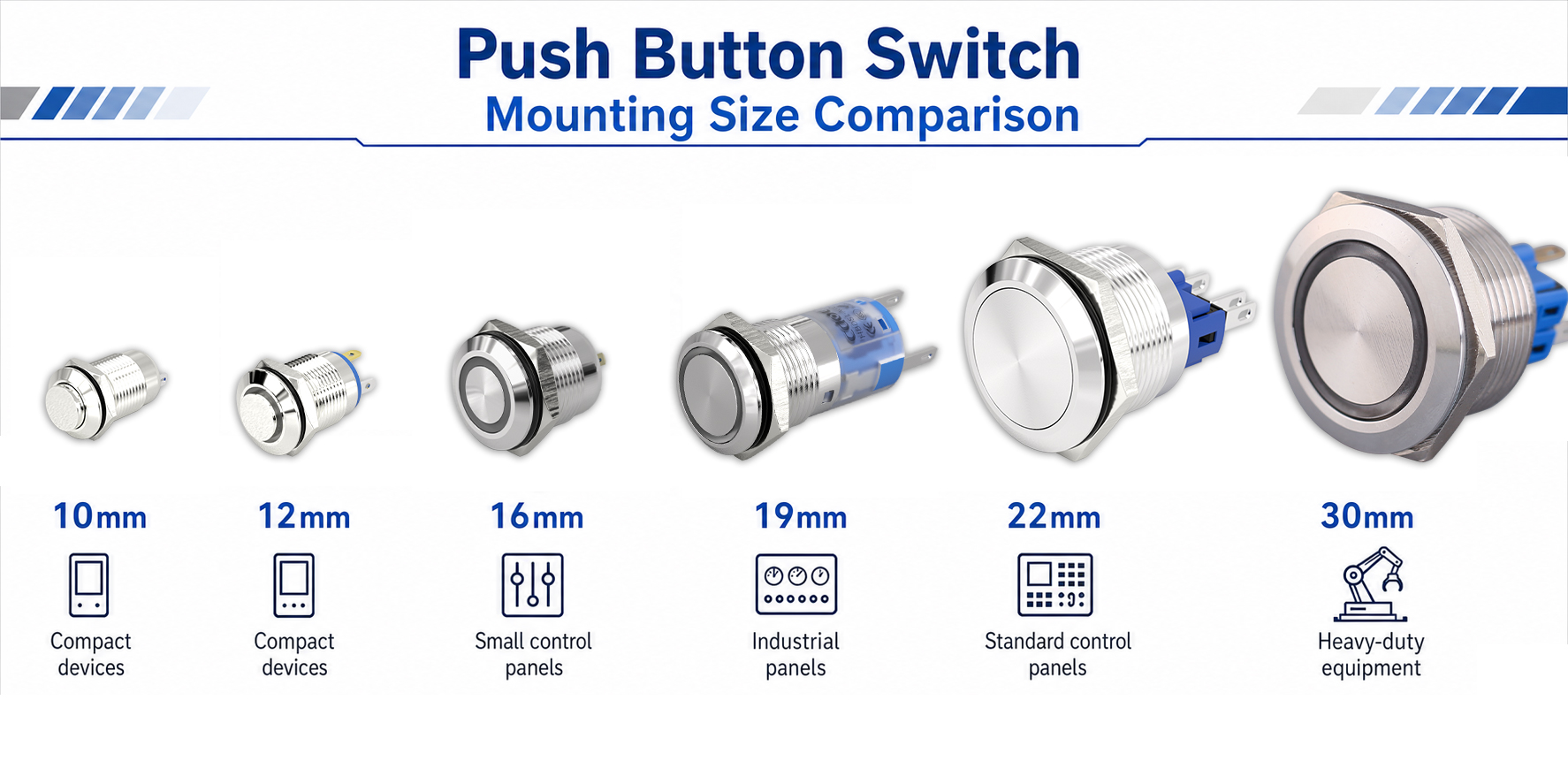
The mounting size is one of the first specifications to check when selecting a panel mount push button switch. The mounting size normally refers to the panel mounting hole diameter required to install the switch.Common industrial push button mounting sizes include:
| Mounting Size | Typical Application |
|---|---|
| 10mm–12mm | Compact equipment, electronic devices and small control panels |
| 16mm | Compact industrial equipment, instrumentation and control systems |
| 19mm | Industrial panels, vending equipment and instrumentation |
| 22mm | Industrial control panels, automation equipment and EV chargers |
| 25mm–30mm | Large control panels and heavy-duty equipment |
| 30mm+ | Large industrial controls and specialized equipment |
CDOE provides metal push button switches in multiple mounting sizes, including 10mm, 12mm, 16mm, 19mm, 22mm, 25mm, 28mm, 30mm and 35mm configurations.
Do not select a switch only according to the visible button diameter. Always confirm the mounting hole diameter, panel thickness and installation dimensions.
How to Choose the Voltage Rating of a Push Button Switch?
The voltage rating of the push button switch should be compatible with the electrical circuit in which the switch contacts are installed. The correct voltage depends on the control circuit,load and switch specification.Common control voltages include:
Switch Contact Voltage vs LED Voltage
Illuminated push button switches normally contain two electrical functions: the mechanical switch contact and the LED indicator. These specifications should be considered separately.
| Specification | Function |
|---|---|
| Contact Voltage Rating | Maximum or rated voltage handled by the switch contacts |
| LED Voltage | Voltage required to operate the indicator LED |
In an illuminated push button switch, the LED circuit and the switching contact circuit are usually independent. A 24V LED does not mean the contacts are only rated for 24V, and a contact rating does not confirm the LED supply voltage. Always verify both specifications before wiring.
How to Choose the Current Rating of a Push Button Switch?
The current rating indicates how much current the switch contacts can safely handle under the specified operating conditions. Current selection should consider more than the normal operating
current.Engineers should evaluate:
- Operating voltage
- AC or DC operation
- Resistive or inductive load
- Inrush current
- Switching frequency
- Electrical life requirements
| Application | Main Consideration |
|---|---|
| PLC Signal Input | Reliable low-current signal switching |
| Relay Control | Verify voltage and contact load requirements |
| Motor Control | Consider inductive load, inrush current and use of contactors or relays |
| Higher-Power Load | Select an appropriate high-current push button or use an external switching device |
A higher current rating does not automatically mean that a switch is suitable for every application. Load type, voltage, switching frequency and electrical life must also be evaluated.For motor or inductive loads, a push button is often used to control a relay, contactor or PLC input instead of switching the load directly.
How to Choose NO, NC or NO+NC Push Button Contacts?
Contact configuration determines how the push button changes the electrical circuit when the actuator is pressed.
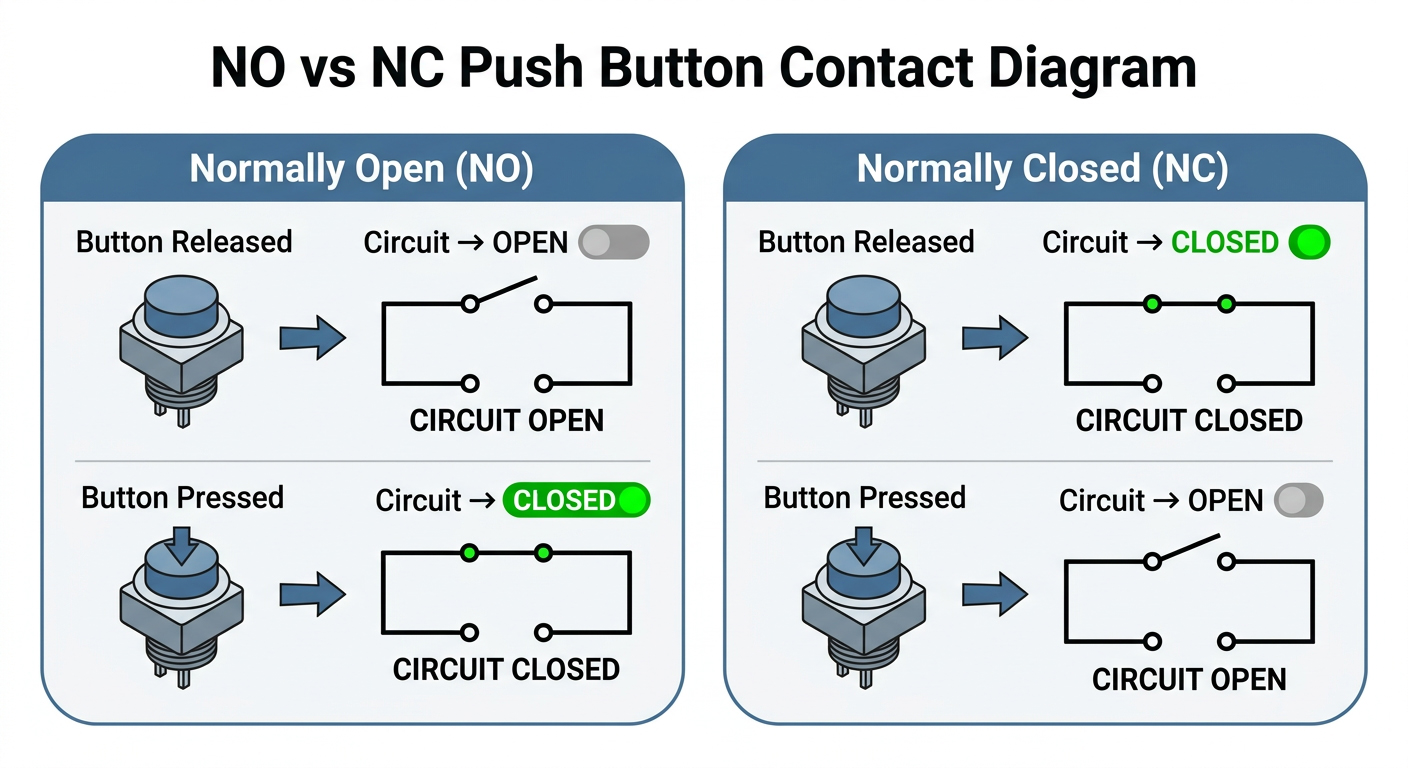
What Is a Normally Open Push Button?
A normally open, or NO, contact remains open when the push button is in its normal position.When the button is pressed, the contact closes and allows the control signal to pass.
NO push buttons are commonly used for:
- Machine start buttons
- Motor start commands
- PLC input signals
- Trigger switches
- Operator control panels
What Is a Normally Closed Push Button?
A normally closed, or NC, contact remains closed when the button is in its normal position.When the button is pressed, the contact opens and interrupts the circuit.
NC push buttons are commonly used for:
- Machine stop functions
- Emergency stop circuits
- Safety control systems
- Protection circuits
- Industrial interlocks
| Feature | NO Contact | NC Contact |
|---|---|---|
| Normal State | Open circuit | Closed circuit |
| Button Pressed | Closed circuit | Open circuit |
| Typical Application | Start, trigger or PLC input | Stop, safety or emergency stop circuit |
Some industrial push buttons provide both NO and NC contacts. A 1NO+1NC configuration can be useful when one button needs to provide different signals to different control circuits.
How to Choose Momentary or Latching Push Button Switches?
Push button switches can generally be selected as momentary or latching depending on how the control circuit should behave.
Momentary Push Button Switch
A momentary push button changes its contact state while the button is pressed and returns to its original state after release.
Typical applications include:
- Machine start
- Reset
- Trigger functions
- PLC input commands
- Operator control
Latching Push Button Switch
A latching push button maintains its switching state after the button is pressed and remains in that state until it is operated again.
Typical applications include:
- Power ON/OFF control
- Mode selection
- Function selection
- Equipment control
For a more detailed comparison, see the Momentary vs Latching Push Button Guide.
How to Choose the IP Protection Rating?
The IP rating indicates the level of protection provided by the switch enclosure against solid particles and water ingress. The correct IP rating depends on the installation environment.Indoor control panels may require less protection than outdoor, wet or industrial environments.
| IP Rating | General Protection | Typical Application |
|---|---|---|
| IP54 | Protection against limited dust ingress and water splashes | Indoor equipment |
| IP65 | Dust-tight and protected against water jets | Industrial equipment and general outdoor applications |
| IP67 | Dust-tight and protected against temporary immersion under specified conditions | Outdoor and wet environments |
| IP68 | Higher-level immersion protection according to specified test conditions | Demanding waterproof applications |
CDOE provides waterproof push button switch solutions with different IP protection options.
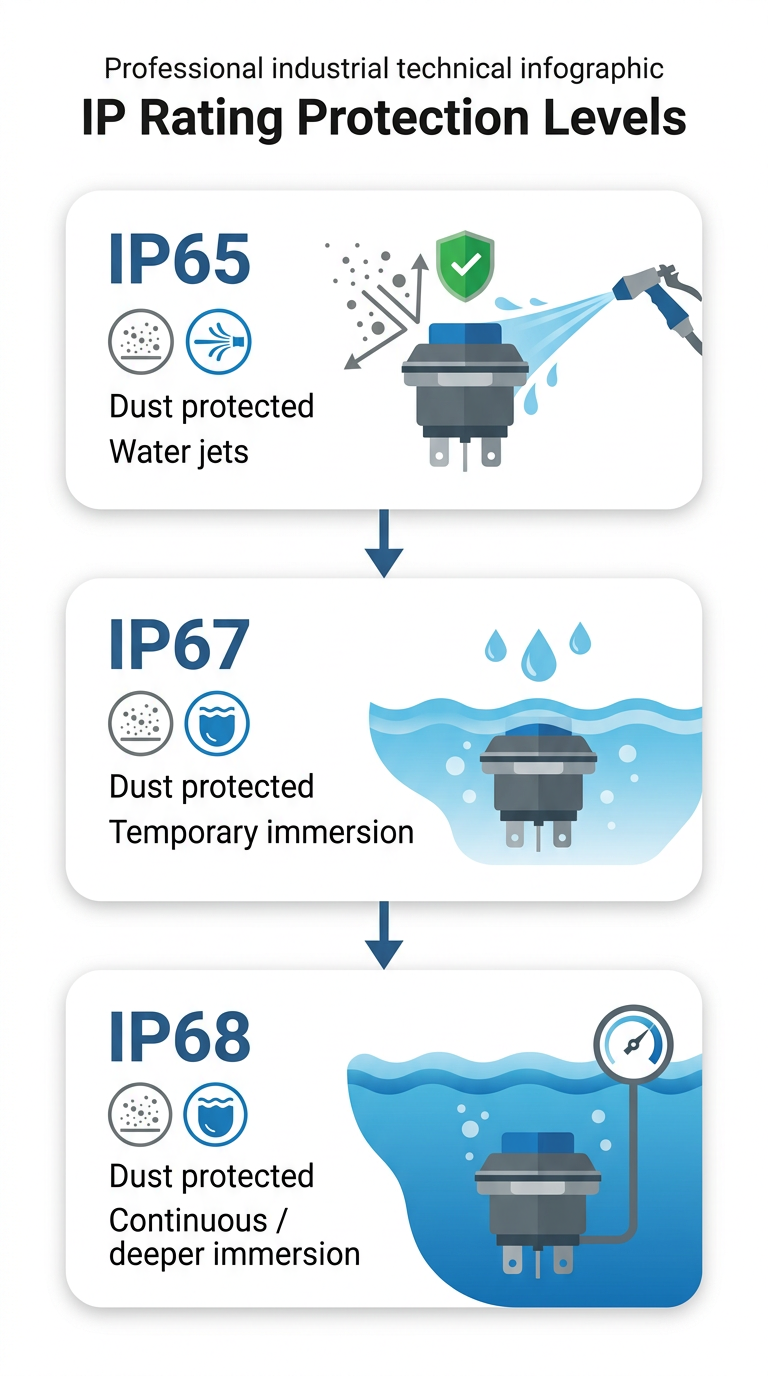
The IP rating of an individual push button does not automatically determine the IP rating of the complete machine or control panel. Panel sealing, cable entry, connectors and installation methods must also be considered.
How to Choose Push Button Switch Material?
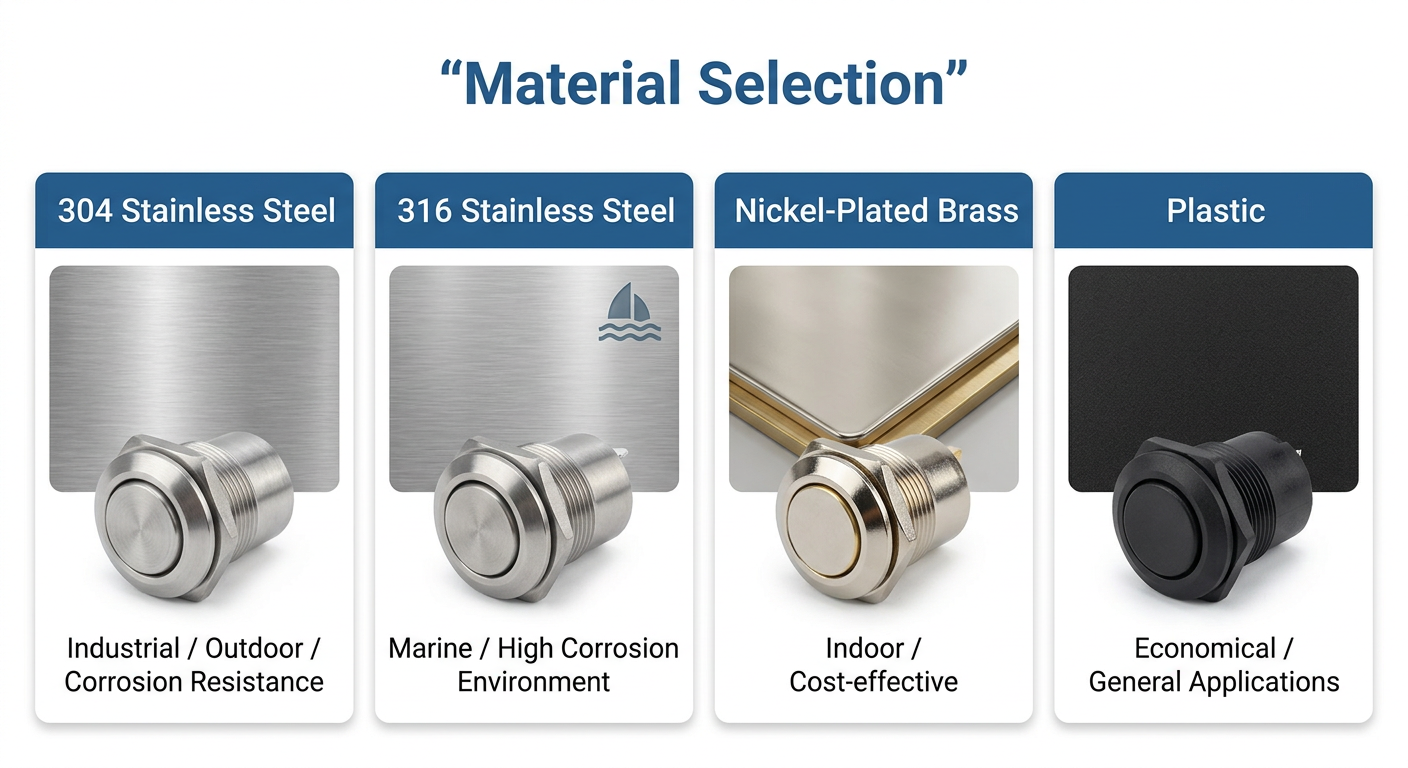
The housing material affects mechanical strength, corrosion resistance, appearance, durability and suitability for different environments.
Stainless Steel Push Button Switch
Stainless steel push buttons are commonly selected for applications requiring durable metal construction, corrosion resistance and mechanical strength.
Typical applications include:
- Industrial equipment
- Outdoor control panels
- EV charging equipment
- Medical equipment
- Anti-vandal applications
304 vs 316 Stainless Steel
| Material | Typical Selection |
|---|---|
| 304 Stainless Steel | General industrial, commercial and outdoor applications |
| 316 Stainless Steel | Applications requiring higher corrosion resistance, such as demanding marine or salt-exposure environments |
Plastic Push Button Switch
Plastic push buttons can be suitable for controlled indoor environments, lightweight equipment and applications where cost and weight are important considerations.
Compare metal push button switches and plastic push button switches according to the requirements of your application.
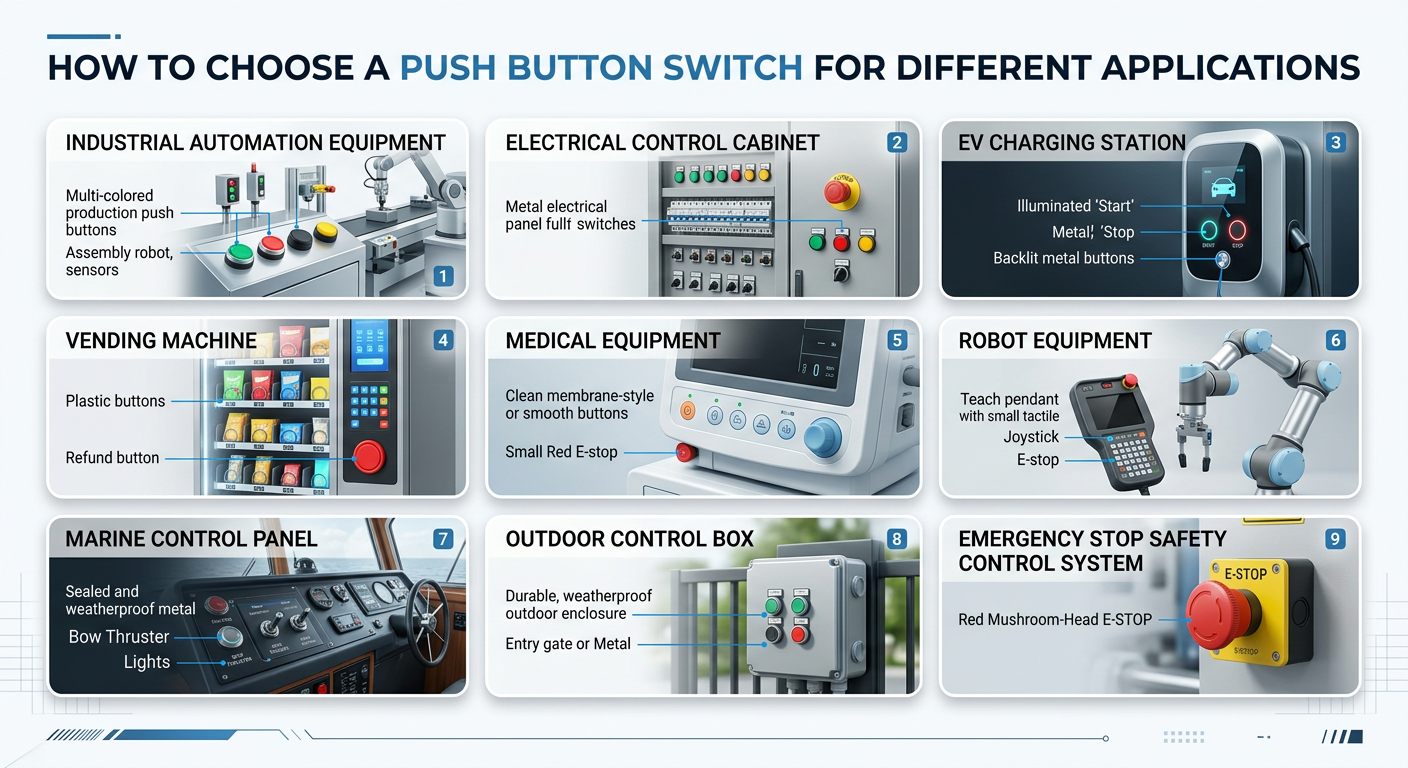
How to Choose a Push Button Switch for Different Applications?
Push button selection should also consider the operating environment, installation conditions and expected frequency of use.
| Application | Recommended Contact | Operation | IP Rating | Material | Notes |
|---|---|---|---|---|---|
| Machine Start | NO | Momentary | IP54–IP65 | Metal or stainless steel | Common for PLC input or start command |
| Machine Stop | NC | Momentary | IP54–IP65 | Metal or stainless steel | Used to interrupt a control circuit |
| Emergency Stop | NC safety contact | Latching or twist release | Depends on system | Durable housing | Must follow machine safety requirements |
| PLC Signal Input | NO or NC | Momentary | IP54–IP65 | Metal or plastic | Select according to PLC control logic |
| EV Charging Equipment | NO or NO+NC | Momentary or latching | IP65–IP67 | Stainless steel | Consider outdoor exposure and LED indication |
| Vending Machine | NO | Momentary | IP54–IP65 | Anti-vandal metal | High operating frequency and impact resistance may be required |
| Marine Panel | NO or NC | Depends on function | IP67–IP68 | 316 stainless steel | Consider moisture, salt spray and corrosion |
| Medical Equipment | NO or NC | Momentary | Depends on cleaning environment | Stainless steel or plastic | Compact size, reliable operation and cleanable surface may be important |
Industrial Automation
Industrial automation equipment often requires durable switches, reliable contacts,appropriate IP protection and high mechanical life. Common mounting sizes include 16mm, 19mm and 22mm.
EV Charging Equipment
EV charging equipment may be installed outdoors and exposed to rain, dust, temperature changes and corrosion. Waterproof protection and illuminated indication may be important.
Robotics Equipment
Robotics applications may require compact mounting, high mechanical life, vibration resistance and stable electrical performance.
Push Button Switch Selection Decision Tree
Use the following quick decision logic to narrow down the correct push button switch type.
1.If the switch is for a start signal
Choose a normally open contact and momentary operation.
2.If the switch is for a stop function
Choose a normally closed contact according to the control circuit design.
3.If the switch controls power ON/OFF
Choose latching operation where a maintained state is required.
4.If the switch is installed outdoors
Choose at least IP65, and consider IP67 for wet environments or greater water exposure.
5.If the switch is used in marine or high-corrosion environments
Consider corrosion-resistant materials such as 316 stainless steel.
6.If the button is illuminated
Check the LED voltage separately from the switch contact voltage and current rating.
7.If the load is a motor or inductive load
Use the push button to control a relay, contactor or PLC input instead of switching the load directly.
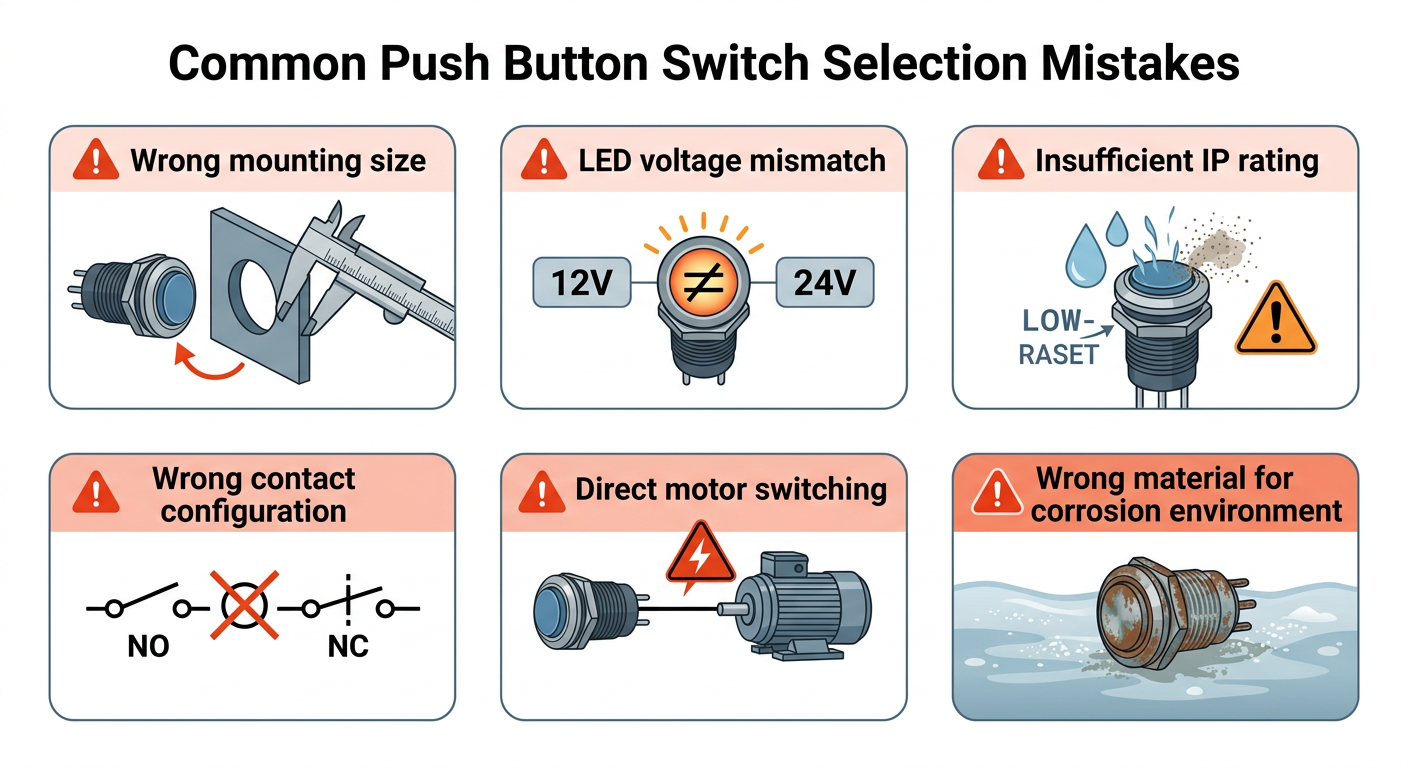
Common Push Button Switch Selection Mistakes
Many push button switch failures are caused by incorrect specification selection rather than the switch itself. The following table summarizes common mistakes, possible results and solutions.
| Mistake | Possible Result | How to Avoid |
|---|---|---|
| Choosing the wrong mounting size | The switch cannot be installed or the panel must be reworked | Confirm the mounting hole diameter and panel thickness before ordering |
| Checking voltage but not current | Contact overheating, welding or premature failure | Check voltage, current, load type and electrical life together |
| Confusing LED voltage with contact rating | The LED may not light or may be damaged | Check LED voltage and switch contact specifications separately |
| Selecting IP protection only from the word waterproof | Water ingress, corrosion or failure in wet environments | Check the actual IP rating and installation conditions |
| Choosing material based only on appearance | Corrosion, impact damage or reduced service life | Consider corrosion, impact, temperature, chemicals and operating environment |
| Selecting only by current rating | Reduced mechanical life or unstable performance | Also check switching frequency, load type and contact configuration |
Push Button Switch Selection Guide Table
The following table provides a quick reference for selecting a push button switch according to common engineering requirements.
| Requirement | Recommended Selection Direction |
|---|---|
| Compact equipment | 10mm–16mm mounting size |
| Industrial control panel | 16mm–22mm mounting size |
| Standard industrial control | 22mm mounting size |
| Large industrial equipment | 25mm–30mm or larger |
| Indoor application | IP54–IP65 depending on environment |
| Outdoor application | IP65–IP67 depending on water exposure |
| Wet environment | IP67 |
| Demanding waterproof application | IP68 where specified conditions require it |
| General industrial metal housing | 304 stainless steel |
| High-corrosion environment | Consider corrosion-resistant materials such as 316 stainless steel |
| Indoor cost-sensitive equipment | Plastic or nickel-plated brass |
| Machine start | NO contact, usually momentary |
| Machine stop | NC contact |
| Emergency stop | NC safety contact and appropriate safety circuit |
| PLC signal | NO or NC according to control logic |
| Power ON/OFF | Latching operation where appropriate |
| Status indication | Illuminated push button |
CDOE Push Button Switch Capabilities
CDOE supplies industrial push button switches for control panels, machinery, EV charging equipment, automation systems, medical equipment, vending machines and self-service equipment.Available options include multiple mounting sizes from 10mm to 35mm, momentary and latching operation, NO, NC and NO+NC contacts, illuminated and non-illuminated models, metal and plastic housings, and waterproof configurations for demanding environments.
Mounting Sizes
10mm, 12mm, 16mm, 19mm, 22mm, 25mm, 28mm, 30mm and 35mm configurations.
Operation & Contacts
Momentary, latching, NO, NC and 1NO+1NC contact configurations for different control logic.
Materials & Protection
Metal, stainless steel, plastic and waterproof push button switch options for indoor and outdoor applications.
Frequently Asked Questions About Push Button Switch Selection
1. How do I choose the right push button switch?
Consider the mounting size, voltage rating, current rating, contact configuration, operation type, IP protection, material and application environment. The correct switch should meet both the electrical and mechanical requirements of the equipment.
2. What mounting size should I choose for a push button switch?
The mounting size should match the panel cutout. Common industrial sizes include 10mm, 12mm,16mm, 19mm, 22mm, 25mm, 28mm, 30mm and 35mm.
3. What is the standard push button size for industrial control panels?
A 22mm push button switch is commonly used in industrial control panels. Compact equipment may use 16mm or 19mm switches, while larger industrial equipment may use 25mm, 30mm or larger mounting sizes.
4. What voltage rating should a push button switch have?
The voltage rating should be compatible with the electrical circuit. For illuminated push buttons, the LED voltage must also match the required power supply.
5. Is LED voltage the same as push button switch contact voltage?
No. The LED voltage refers to the indicator light circuit, while the switch contact rating refers to the voltage and current handled by the switching contacts. These specifications should be checked separately.
6. What IP rating should I choose for outdoor applications?
IP65 may be suitable for dust and water spray, while IP67 or IP68 may be required for applications exposed to greater water exposure or immersion. The complete installation should be considered, including panel sealing, cable entry and connectors.
7. What is the difference between momentary and latching push buttons?
A momentary push button operates while pressed and returns after release. A latching push button maintains its state after activation until it is pressed or operated again.
8. Should I choose a metal or plastic push button?
Metal push buttons are generally preferred when durability, impact resistance or corrosion resistance is important. Plastic push buttons can be suitable for controlled indoor environments and cost-sensitive applications.
9. What is the difference between NO and NC push buttons?
A normally open contact remains open until the button is pressed. A normally closed contact remains closed until the button is pressed. NO is commonly used for start and trigger functions,while NC is commonly used for stop and safety-related circuits.
10. What is the best push button switch for a PLC input?
A momentary NO push button is commonly used for PLC start or trigger inputs, while NC contacts may be used for stop or safety-related input logic depending on the control design.
11. Can a push button switch control a motor directly?
In many industrial systems, a push button should be used to control a relay, contactor or PLC input rather than switching a motor load directly, especially when inductive load or inrush current is involved.
12. Can a push button have both NO and NC contacts?
Yes. Many industrial push buttons can be configured with both NO and NC contacts, allowing one switch to provide different signals to different control circuits.
13. Can a 12V push button be used in a 24V system?
It depends on the switch and LED specifications. For an illuminated push button, a 12V LED should not be connected directly to a 24V supply unless the product is specifically designed for that voltage. Always verify the manufacturer's specifications.
14. How do I choose between 304 and 316 stainless steel push buttons?
304 stainless steel is suitable for general industrial, commercial and outdoor applications.316 stainless steel is preferred for high-corrosion environments such as marine or salt-exposure applications.
15. What information should I provide when requesting a push button switch?
Provide the mounting hole size, operation type, contact configuration, voltage, current, IPprotection requirement, material and application environment. For illuminated models, also specify the LED voltage and color when required.
Conclusion: Choosing the Right Push Button Switch
Selecting the correct push button switch requires consideration of mechanical, electrical and environmental requirements. Before selecting a switch, always check mounting size, voltage rating,current rating, contact configuration, momentary or latching operation, IP protection, housing material and application environment.
By matching these specifications to the actual equipment requirements, engineers and purchasing teams can reduce installation problems, contact failure, environmental damage and unnecessary replacement costs.
CDOE provides industrial push button switches in multiple mounting sizes, contact configurations,materials, operating modes and protection levels for industrial automation, control panels,machinery, EV charging, medical equipment and other applications.
Need Help Selecting a Push Button Switch?
Contact the CDOE technical team with your mounting size, voltage, current, IP requirement,material preference and application environment. Our team can help you select the appropriate industrial push button switch for your equipment.